Forge of Empires World Map Complete Guide 2026: Provinces, Battles, and Expansion
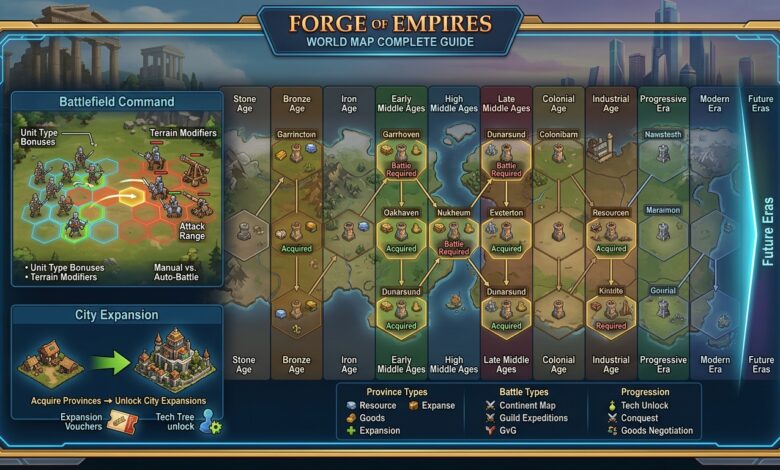
Table of Contents
| Section | Description |
|---|---|
| Introduction to the World Map | Basic concept and importance |
| Structure of the World Map | Provinces, sectors, and continents |
| How to Unlock and Conquer Provinces | Step-by-step conquest guide |
| Battle System on the World Map | Fighting vs. negotiating |
| Rewards from World Map Conquest | Expansions, goods, and diamonds |
| Continental Map vs. Guild vs. PvP | Key differences explained |
| Advanced Strategies for Map Progression | Efficiency and resource management |
| Frequently Asked Questions (FAQs) | Common player queries |
Introduction to the Forge of Empires World Map
The World Map in Forge of Empires is the primary strategic landmass where players expand their empire beyond the confines of their city. Unlike the city builder aspect, the World Map focuses on tactical conquest, resource acquisition, and territorial expansion. Every player starts on a randomized segment of the map but progresses through the same fixed continents. The map is not infinite it consists of specific ages and provinces that must be conquered in sequence.
Understanding the World Map is critical because it directly unlocks expansions for your city, provides valuable goods and units, and allows access to higher age provinces. Without conquering the World Map, your city growth will halt due to lack of space. The map also serves as the battleground for player versus environment encounters, which are essential for completing events and quests.
Structure of the World Map Provinces and Sectors
The Forge of Empires World Map is divided into major continents that correspond to each age. For example, the Bronze Age continent is called the Stone Age Map, followed by the Iron Age continent, and so on up to the Space Age maps. Each continent is further subdivided into provinces. A province is a defined territory that contains multiple sectors. A sector is the smallest conquerable unit on the map.
Typically, a province has four to six sectors. To fully control a province, you must conquer all its sectors. Every sector is defended by a specific army composition based on the province’s age. Some sectors are neutral, while others belong to computer-generated opponents or other players in certain map versions. The game originally used a neighborhood map where players were adjacent to each other, but modern Forge of Empires uses a fixed continental map for campaign progression. The old neighborhood map still exists in the form of player versus player towers, but the primary World Map for expansion is the single-player campaign map.
How to Unlock and Conquer Provinces on the Forge of Empires Map
Conquering a province requires a sequential approach. You cannot jump to a later age province without first clearing the previous age provinces. To unlock a new province, you must either conquer the adjacent province or reach a certain age in your city technology tree. The game uses a fog of war system. Unexplored provinces are dark until you scout them. Scouting costs coins and takes time, but it is an automatic process. Once a province is scouted, you see its sectors and the difficulty level. Difficulty is indicated by skulls. One skull means easy, three skulls mean very hard.
To conquer a sector, you have two choices fight or negotiate. Fighting involves a turn-based tactical battle using your military units. You deploy up to eight units per battle, and the defender’s army is automatically placed. Winning removes the defending army from that sector. Negotiation requires spending specific goods from your inventory. The negotiation screen shows a set of required goods, and you must correctly match them. Each wrong guess costs more goods. Negotiation is faster but more expensive in terms of resources. After conquering all sectors of a province, you receive a reward. The final sector in a province always grants a major reward such as a city expansion, a military unit, or a large amount of goods.
Battle System on the World Map Tactical Combat
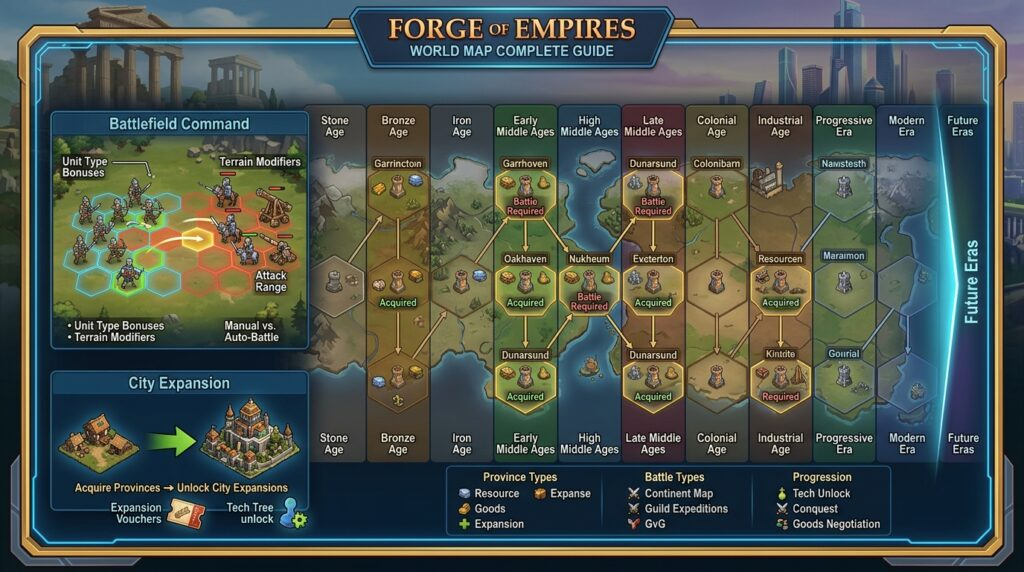
The battle system on the World Map is turn-based and hex grid based. Each unit type has unique movement ranges, attack styles, and defensive bonuses. Heavy units have high health but low mobility. Fast units like cavalry cover long distances and deal bonus damage to ranged units. Ranged units attack from a distance but have low health. Artillery units ignore terrain penalties but are slow. Light units are balanced. Understanding unit counters is essential for winning battles with minimal losses.
You can also use rogues, which are special units that transform into the last surviving friendly unit type. Rogues are powerful in large groups because they absorb hits while disguised. Before each battle, you see the enemy composition. You can change your army lineup to counter the enemy. For example, if the enemy uses many heavy units, deploy artillery or fast units. If the enemy uses many ranged units, use cavalry. Winning a battle without losing any units is called a perfect victory, which gives higher battle points. Battle points contribute to your player score and ranking.
If you lose a battle, your units are wounded and must be healed in your city’s military buildings. Healing takes time, but you can speed it up with diamonds. Alternatively, you can negotiate instead of fighting. Many players combine both tactics. They fight easy sectors and negotiate difficult sectors with high losses.
Rewards from World Map Conquest Expansions and Diamonds
The single most important reward from the World Map is the expansion. Each expansion permanently increases your city’s buildable area. Without these expansions, you cannot place all your buildings. The game provides two types of expansions from the map. First, you get one expansion every time you fully conquer a province that has an expansion icon on its reward list. Second, you get medal expansions by reaching certain medal thresholds, but those medals are also earned partly from map provinces.
Other rewards include forge points, which are used to research technologies and contribute to great buildings. You receive goods from your age and lower ages. These goods are needed for negotiating future provinces and for trading. Diamonds are the premium currency. Some provinces, especially on later continents, give diamond rewards. Diamonds are rare to find on the map, but they exist. Replaying provinces is not possible, so diamonds are a one-time reward per province. Another reward is military units. Some provinces give you a free unit of a specific type. This is useful if you lack a high-age unit.
Continental Map versus Guild Map versus Player versus Player Map
Many new players confuse three different maps in Forge of Empires. The primary map discussed here is the Continental Map, also called the Campaign Map. This map is single-player and never resets. It is the same for every player regardless of guild. You progress through ages in order. The second map is the Guild Continent Map. This appears in the Guild vs. Guild feature. On this map, your entire guild battles against other guilds for control of sectors. The Guild Map is seasonal and resets after each league season. It uses guild goods and guild armies, not your personal units.
The third map is the neighborhood map. Historically, this was the original World Map where players saw each other’s cities adjacent. That system was replaced by the Friends Tavern and the ranking lists. Today, the neighborhood concept exists only through the PvP Arena and Tower. The PvP Tower rewards players who fight other players on the Continental Map or Guild Map. However, you do not directly attack another player’s city. Instead, you fight armies that represent other players’ defending armies. So the modern Forge of Empires World Map is primarily a fixed PvE campaign with indirect PvP elements through rankings.
Advanced Strategies for Efficient World Map Progression
Do not rush the World Map. Progressing too fast into higher age provinces without corresponding city strength leads to expensive negotiations or impossible battles. Enemy armies scale with the province age. If you enter a Modern Era province with Iron Age units, you will lose instantly. Always balance your map progression with your technology research. A common strategy is to stay one age behind on the map. For example, if your city is in the Late Middle Ages, only conquer High Middle Age provinces. This keeps battles manageable.
Another advanced tactic is to use Champions and Rogues. Champions are heavy units with a bonus on first strike. Rogues transform into champions after the first hit, creating an army of champions. This setup can clear many provinces without losses. Also, always scout new provinces immediately even if you do not plan to fight them. Scouting takes time, so starting the scout early saves waiting later. Additionally, complete all provinces of an age before moving to the next continent because some recurring quests require conquering sectors on your current age map.
For players who hate fighting, the negotiation path is viable but requires a strong goods production. Build many goods buildings and trade for needed goods. Focus on goods from your age and one age below. Always keep a stockpile of at least 500 of each good for negotiating multiple sectors. Use the friend list to trade goods at fair rates 1 to 1 for same age goods. Never negotiate with diamonds unless the reward is an expansion.
Frequently Asked Questions About the Forge of Empires World Map
- How many provinces are on the Forge of Empires World Map?
There is no single fixed number because new ages are added every year. As of the latest updates, there are over 200 provinces across all ages from Bronze Age to Space Age Jupiter Moon. - Can I reset my World Map progress?
No. The Continental Map cannot be reset or replayed. Each province can be conquered only once. This makes your choices permanent. - What happens if I cannot beat a province?
You have two options. First, improve your military technology and units in your city. Second, use the negotiation option instead of fighting. If both fail, wait until you age up to unlock better units. - Do other players occupy the same World Map sectors?
No. On the single-player Continental Map, sectors are controlled only by computer opponents. Other players never take your conquered provinces. Guild vs. Guild map is separate. - How do I get more expansions from the map?
Look for province icons that show a green expansion symbol. Only those provinces provide city expansions. Conquer all sectors of that province to claim the expansion. - Is it better to fight or negotiate on the World Map?
Fighting is better for long term resource management because it costs only unit healing. Negotiation costs goods which are harder to replace. However, negotiation is instantly repeatable without waiting for healing. - What is the fastest way to clear the World Map?
Use a full army of rogues with one champion or one heavy unit. Auto-battle most sectors if the difficulty is two skulls or less. For three skulls, manually control your army. Negotiate only when enemy armies counter your best units. - Why is a province locked even after scouting?
A province is locked if you have not yet conquered the previous connecting province. Follow the visible lines on the map. You must conquer provinces in order.