Forge of Empires Champion 2026: The Ultimate Guide to Champion Units and Their Role
1. Introduction to the Forge of Empires Champion
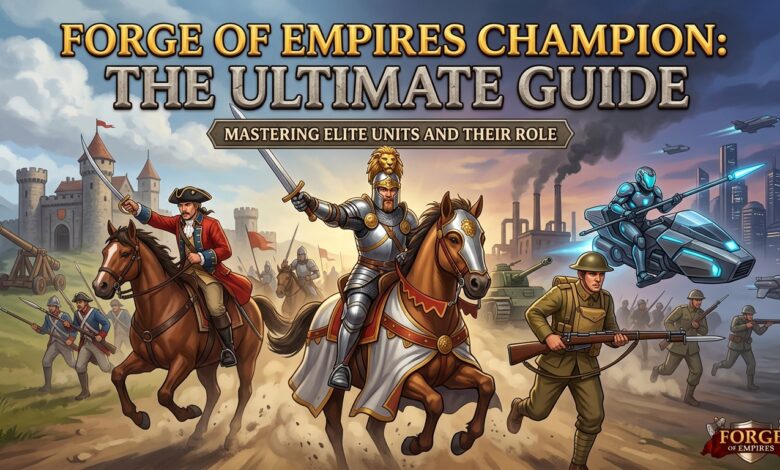
In the world of Forge of Empires, military strength determines a player’s ability to conquer provinces, defend cities, and dominate competitive guild events. Among the many units available across different ages, one of the most intriguing and specialized units is the Forge of Empires Champion. This heavy melee unit is not available through standard barracks or military buildings. Instead, it requires a unique structure and strategic dedication to unlock. This article provides a complete breakdown of the Champion unit, including its stats, abilities, tactical uses, and comparison with other heavy units. Players looking to strengthen their army composition will find valuable insights into how the Champion can turn the tide of battle when used correctly.
2. Empires :What Is a Champion Unit in Forge of Empires
A Champion in Forge of Empires is a special heavy melee unit that belongs to a dedicated champion system. Unlike regular units that are trained in age-specific military buildings, Champions are produced exclusively from the Champion’s Retreat. This building becomes available only after a player has constructed the King’s Castle and upgraded it through several levels. Champions are unique because they are not tied to a specific age in the way that soldiers, archers, or artillery units are. Instead, the Champion gains power as the player progresses through ages. When a player advances to a new age, the Champion unit automatically upgrades to the corresponding age variant. This means the Forge of Empires Champion remains relevant throughout the entire game, from the Early Middle Ages to Space Age Mars and beyond.
3. How to Unlock the Champion Unit
Unlocking the Champion requires the player to build and level the King’s Castle. The King’s Castle becomes available in the Early Middle Ages. However, simply constructing the castle is not enough. The King’s Castle must be upgraded to level 10 to unlock the Champion’s Retreat. Once the retreat is built, players can train Champions. Each Champion’s Retreat produces one Champion per day, and the capacity can be increased by building additional Champion’s Retreats. However, multiple retreats are difficult to acquire because the King’s Castle only grants one retreat at level 10. Additional retreats can be obtained from special events, the Antiques Dealer, or as rewards from high-level guild expeditions. Therefore, players must carefully manage their Champion count. The cost of training a Champion includes coins and supplies, but the time cost is significant. Players often use diamonds to speed up production during emergencies.
4. Empires :Champion Unit Stats and Abilities
The Forge of Empires Champion is classified as a heavy melee unit. Its base stats vary by age, but certain characteristics remain consistent. Champions have above-average hit points and high attack values against other melee units. Their primary ability is Combat Aura. This ability provides a defensive boost to all adjacent friendly units. When a Champion stands next to another unit, that unit receives a defense increase. This makes the Champion not only a frontline fighter but also a support unit. The Champion has no range attack and must move into direct contact with enemies to deal damage. This limitation requires careful positioning. In higher ages, Champions gain additional bonuses, including reduced damage from ranged units and extra retaliation damage. Compared to standard heavy units like the Knight or Paladin, the Champion trades raw individual attack power for team-wide defensive benefits. This makes the Champion more effective in large battles where multiple units can receive the aura.
5. Champion vs Other Heavy Melee Units
To understand the full value of the Forge of Empires Champion, a direct comparison with other heavy melee units is necessary. Below is a comparison table focusing on general characteristics across the Middle Ages.
| Feature | Champion | Knight (High Middle Ages) | Paladin (Late Middle Ages) |
|---|---|---|---|
| Unit Type | Heavy Melee | Heavy Melee | Heavy Melee |
| Special Ability | Combat Aura (adjacent allies get +5 defense) | No special ability | First Strike (attacks first when defending) |
| Training Building | Champion’s Retreat | Knight Stable | Knight Stable |
| Upgrade with Age | Yes, automatic | No, age-locked | No, age-locked |
| Production Time | 24 hours per unit | 4 hours | 4 hours |
| Best Use | Support + frontline | Pure attack | Defensive counter |
| Weakness | Ranged units, artillery | Ranged units, artillery | Fast units, artillery |
The table shows that the Champion is slower to produce but offers long-term value. While Knights and Paladins are easy to mass produce, they become obsolete when the player ages up. The Champion continues to evolve. Additionally, the Combat Aura gives Champions a tactical role that no other heavy unit provides. In battles where players use mixed armies of ranged and fast units, placing Champions adjacent to fragile units like archers or siege weapons increases survival rates dramatically.
6. Empires :Best Strategies for Using Champions
Effective use of the Forge of Empires Champion requires a shift in mindset. Champions should not be used as pure damage dealers. Instead, they function as durable anchors for the army formation. The following strategies maximize their potential.
First, use Champions in a two-unit formation. Place two Champions side by side at the front line. Their Combat Aura abilities stack, meaning each Champion receives defense bonuses from the other. This creates a highly resilient wall. Behind them, position ranged units such as archers or crossbowmen. The enemy will engage the Champions first, while the ranged units deal damage safely.
Second, avoid sending Champions alone against artillery. Champion units have high defense, but artillery pieces ignore some defense stats. Always pair Champions with fast units like Lancers or Rangers. Fast units can move around the flanks and destroy enemy artillery before it concentrates fire on the Champions.
Third, use Champions in defense armies for your city. When other players attack your city, the Combat Aura triggers automatically. Defending Champions boost all adjacent defending units. This can turn a standard defense into a deadly trap. Placing Champions in city defense slots near other heavy units or ranged units reduces the attacker’s chance of a quick victory.
Fourth, do not overproduce Champions. Because each Champion takes 24 hours to train, relying solely on Champions limits army size. Maintain a core group of four to six Champions and supplement with mass-produced age-specific units. Use Champions only for difficult battles such as level 4 of Guild Expeditions or high attrition fights in Guild Battlegrounds.
7. Empires :Champions in Guild Battlegrounds and Guild vs Guild
In competitive guild content, the Forge of Empires Champion shines as a specialist. In Guild Battlegrounds, attrition reduces unit effectiveness. Because Champions have high base defense plus the Combat Aura, they suffer less from attrition penalties than standard units. Players who have accumulated multiple Champion’s Retreats can field an army of eight Champions. Such an army walks slowly across the battlefield, but each Champion boosts the others. This creates a nearly unbreakable formation. However, this strategy fails against enemy armies that include multiple artillery units or rogue units. Rogues can confuse the AI and bypass the Champion wall.
In Guild vs Guild (GvG), Champions are used to defend siege armies placed on sectors. A defending army with two Champions and six ranged units often forces attackers to lose multiple waves. The key is to position Champions in slots 1 and 8 of the defense formation. This ensures they cover the entire frontline. Attackers who do not prepare anti-heavy units will lose many troops. For offensive GvG, Champions are slower but useful for holding captured sectors while allies reinforce.
8. Common Mistakes When Using Champions
Many players misunderstand the Forge of Empires Champion and use it inefficiently. The most common mistake is treating Champions as solo fighters. Without allies nearby, the Champion loses its primary advantage. A single Champion fighting alone is weaker than a Knight of the same age. Always keep Champions near at least one other friendly unit.
The second mistake is using Champions against all enemy types. Champions perform poorly against fast units and artillery. Fast units can move around the Champion and attack backline units. Artillery destroys Champions from a distance before the Champion can close the gap. Scout the enemy army before deploying Champions. If the enemy has more than three artillery or fast units, use a different army composition.
The third mistake is neglecting Champion’s Retreat production. Because production takes 24 hours, some players forget to collect Champions daily. Set a reminder to collect every 24 hours. Losing even one day of production reduces the Champion pool over time.
The fourth mistake is using Champions in low-level battles. For routine fights against easy provinces or low-level encounters, standard units are more cost-effective. Save Champions for high-difficulty battles where their durability and aura provide genuine advantage.
9. Frequently Asked Questions (FAQs)
Q1: How do I get my first Champion in Forge of Empires?
A1: Build the King’s Castle and upgrade it to level 10. Then build the Champion’s Retreat. Train your first Champion from the retreat in 24 hours.
Q2: Can I have more than one Champion’s Retreat?
A2: Yes, but only one is given from the King’s Castle. Additional retreats can be obtained from special events, the Antiques Dealer, or high-level guild expedition rewards.
Q3: Do Champions upgrade automatically when I change ages?
A3: Yes. When you advance to a new age, all existing Champions in your army automatically become the new age version. This is a major advantage over standard units.
Q4: Is the Champion better than the Paladin?
A4: It depends on the situation. For solo attacks, the Paladin does more damage. For supporting a mixed army, the Champion is better because of Combat Aura.
Q5: How many Champions should I keep in my army?
A5: Four to six Champions are sufficient for most players. Eight Champions can be used for specialized attrition builds in Guild Battlegrounds.
Q6: Does Combat Aura stack with multiple Champions?
A6: Yes. Each Champion provides the aura to adjacent allies. Two Champions next to each other both receive each other’s bonus.
Q7: Can Champions be used in the Guild Expedition?
A7: Yes. Champions are very effective in level 3 and level 4 of the Guild Expedition where enemy armies are large and varied.
Q8: What is the biggest weakness of the Forge of Empires Champion?
A8: Artillery units and fast units. Artillery damages Champions from range. Fast units bypass Champions to attack ranged allies.
10. Conclusion
The Forge of Empires Champion is one of the most rewarding units to master in the game. It is not a unit for every situation. It requires patience to train, strategic placement in battle, and an understanding of its Combat Aura ability. However, for players who invest the time to unlock and produce Champions, the payoff is a versatile unit that never becomes obsolete. Champions provide defensive support that no other heavy melee unit can match. They anchor armies, protect fragile damage dealers, and dominate in guild wars when attrition is high. By avoiding common mistakes and applying the strategies outlined in this guide, any player can turn the Champion into the centerpiece of their military. Remember to always pair Champions with allies, avoid artillery, and collect from your Champion’s Retreat daily. With these practices, the Forge of Empires Champion will lead your empire to victory across every age.