Forge of Empires Goods: 2026 The Ultimate Guide to Producing, Trading, and Managing Resources
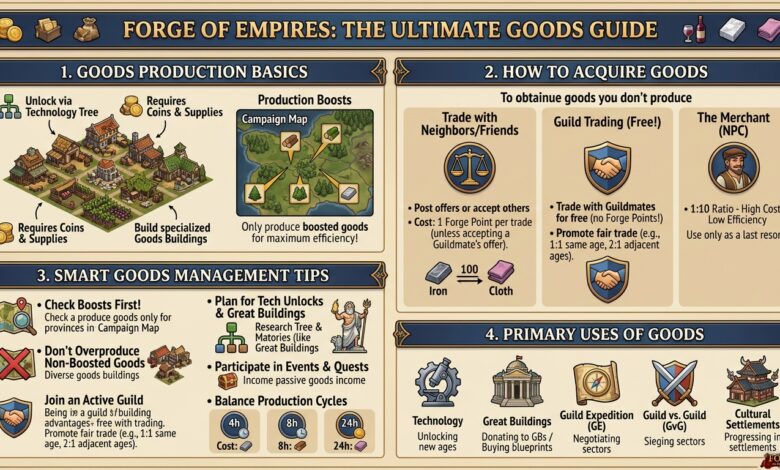
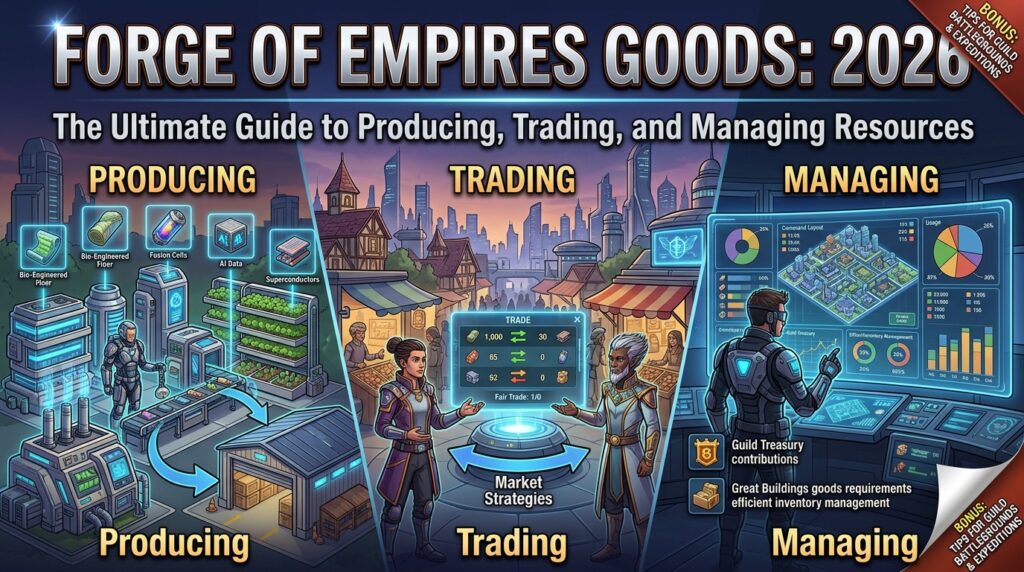
Forge of Empires goods are the lifeblood of your city’s progress in this popular strategy game. Without a steady supply of goods, you cannot negotiate in the Guild Expeditions, unlock certain technologies, complete map sectors, or trade with other players. Understanding how to produce, manage, and trade goods efficiently can mean the difference between a thriving empire and a stagnant one. This comprehensive guide covers every aspect of goods in Forge of Empires, from basic production to advanced trading strategies.
Empires :What Are Goods in Forge of Empires?
Goods are resources produced by goods buildings, special event buildings, and Great Buildings. Each age in Forge of Empires introduces a new set of goods, typically two types per age. For example, the Bronze Age has lumber and stone, while the Iron Age has iron and limestone. Goods are categorized as either regular goods or refined goods. Regular goods come from standard goods buildings, while refined goods appear starting in the Progressive Era and require unrefined goods from the previous age to produce.
Types of Goods by Age
Every age from Bronze to Space Age Titan features unique goods. Below is a table outlining the goods available in each major era.
| Age | Goods Type 1 | Goods Type 2 |
|---|---|---|
| Bronze Age | Lumber | Stone |
| Iron Age | Iron | Limestone |
| Early Middle Ages | Alabaster | Copper |
| High Middle Ages | Gold | Granite |
| Late Middle Ages | Honey | Glass |
| Colonial Age | Porcelain | Coffee |
| Industrial Age | Bronze | Brass |
| Progressive Era | Asbestos | Tinplate |
| Modern Era | Gears | Lubricants |
| Postmodern Era | Silicon | Paper |
| Contemporary Era | Bioplastics | Nanowires |
| Tomorrow Era | Ethanol | Uranium |
| Future Era | Helium | Superalloys |
| Arctic Future | Arctic Timber | Cryogenics |
| Oceanic Future | Coral | Nanites |
| Virtual Future | Biomaterials | Synthetics |
| Space Age Mars | Martian Mud | Aerogel |
| Space Age Asteroid Belt | Gliese Ore | Cryo Chemicals |
| Space Age Venus | Heliconium | Promethium |
| Space Age Titan | Titanium Alloys | Dark Matter |
Empires : How to Produce Goods
There are multiple ways to produce goods in Forge of Empires. Each method has its own advantages and limitations.
Standard Goods Buildings
These are production buildings available in the build menu. Each goods building produces one specific good from your current age. The production time can be set to 5 minutes, 15 minutes, 1 hour, 4 hours, 8 hours, or 1 day. Longer production times yield more goods per collection but fewer goods per hour. Standard goods buildings require population and coins, and they have a happiness impact on your city.
Event Buildings
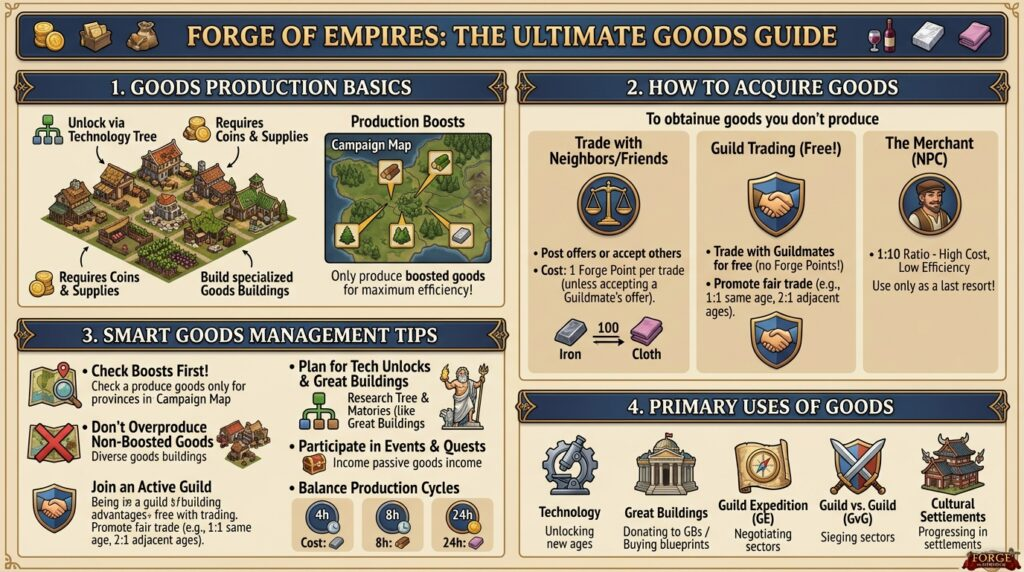
Many special buildings from events provide goods daily. These buildings often produce goods from your current age without requiring population or causing unhappiness. Examples include the Governor’s Villa, Winter Spire, and Eagle Mountain. Some event buildings produce goods from multiple ages simultaneously, which can be very valuable for trading.
Great Buildings
Several Great Buildings produce goods daily. The most notable is the Lighthouse of Alexandria, which provides goods and boosts supply production. The St. Mark’s Basilica produces coins and goods. The Rain Forest Project increases the chance of finding blueprints and also produces goods. Higher levels of these Great Buildings increase the quantity of goods produced each day.
Guild Expeditions and Settlements
Completing encounters in the Guild Expeditions often rewards goods. Similarly, progressing through settlements like the Viking, Egyptian, Japanese, or Aztec settlements yields goods as rewards. These goods are typically from your current age or from the settlement’s specific age.
Empires : Trading Goods
Trading is essential because you cannot produce every type of good from your age on your own. Most players specialize in producing one type of good per age and trade for the other type.
Fair Trade Ratios
The standard fair trade ratio across the same age is 1:1 for goods of the same age. However, players commonly accept 2:1 ratios for trading up one age (two current age goods for one next age good) or 1:2 for trading down one age (one current age good for two previous age goods). For cross-age trades involving multiple age gaps, ratios vary by guild and market conditions.
Trade Offers
You can place trade offers in the Market. Trade offers can be public for all players on your server or private for only your guild members. Each trade offer costs a small number of forge points to post. Trades that are fair and reasonable tend to fill quickly. Unfair trades, such as asking for 100 Iron Age goods for 1 Bronze Age good, rarely get accepted.
Empires : Guild Trading
Being in an active guild greatly simplifies trading. Guild members often trade among themselves at better rates than public markets. Many guilds enforce fair trade policies to ensure all members can progress. Use your guild’s trade thread on the message board to request specific goods.
Empires : Refined Goods Explained
Starting in the Progressive Era, goods become refined. To produce refined goods, you need unrefined goods from the previous age. For example, producing Asbestos (Progressive Era) requires Tinplate (Industrial Era). This creates a dependency chain that forces you to maintain goods production across multiple ages. Refined goods are necessary for negotiating higher-age sectors on the Continent Map and for certain technologies.
Empires : Managing Goods Efficiently
Efficient goods management involves balancing production, consumption, and trading.
Prioritize Daily Goods Production
Event buildings and Great Buildings that produce goods daily require no manual collection scheduling. Prioritize obtaining these buildings during events. They give passive goods income without tying up population or space.
Empires : Use Production Boosts
The Lighthouse of Alexandria and the Royal Albert Hall increase production from goods buildings. Boost your goods production by building these Great Buildings and leveling them up. Also, use tavern boosts and guild boosts to increase output.
Avoid Overproduction
Producing too many goods from one age while neglecting another age leads to imbalance. Monitor your stock levels. If you have 5,000 of one good and only 200 of the other, produce the short good or trade some surplus.
Complete Guild Expeditions Weekly
Guild Expeditions reward a selection of goods from various ages. Even if you cannot complete all four levels, doing as many encounters as possible gives free goods. Level 4 of the Guild Expedition offers the best goods rewards.
Goods for Negotiations
Negotiations in the Guild Battlegrounds, Guild Expeditions, and on the Continent Map require goods. Each negotiation attempt consumes goods even if you fail. To save goods, use the Forge of Empires wiki or external negotiation tools to deduce the correct combination before spending goods. Alternatively, use tavern boosts that reduce negotiation costs.
Empires : Common Mistakes to Avoid
Avoid trading away all your goods of one type. You may need them later for technologies or map sectors. Do not rely solely on standard goods buildings for production. They are inefficient compared to event buildings and Great Buildings. Also, do not ignore refined goods chains. If you jump ahead in ages without producing unrefined goods, you will struggle to produce refined goods.
Empires : Advanced Goods Strategy
For advanced players, maintaining a goods farm in a lower age is a powerful strategy. By staying in the Iron Age or Early Middle Ages, you can produce large quantities of cheap goods and trade them up to higher ages. Since lower-age goods are easier to produce in bulk, you can accumulate thousands of them and then use the market to trade upward. This works best if you have a high-level Château Frontenac, which boosts quest rewards including goods.
Empires : FAQs
Q1: How many goods buildings should I have in my city?
It depends on your playstyle and available space. For casual players, 2 to 4 goods buildings per age are sufficient. For active traders and negotiators, 6 to 8 goods buildings may be necessary. Supplement with event buildings to reduce reliance on standard goods buildings.
Q2: Can I produce goods from previous ages?
Yes, you can build goods buildings from previous ages if you have not sold them. However, they take up valuable city space. Most players keep only current age goods buildings and rely on trading or event buildings for older goods.
Q3: What is the best Great Building for goods production?Empires.
The Lighthouse of Alexandria is widely considered the best because it also boosts supply production. The Rain Forest Project is good for obtaining blueprints while producing goods. The Château Frontenac boosts goods from quests, not from buildings.
Q4: How do I get refined goods without previous age goods?
You cannot. You must produce unrefined goods from the previous age or trade for them. If you lack unrefined goods, ask guild members for help or place trades requesting previous age goods in exchange for current age goods.
Q5: Are goods from event buildings better than from standard buildings?
Yes. Event buildings produce goods daily without requiring population, coins, or manual production cycles. Many event buildings also provide other benefits like forge points, attack boosts, or happiness.
Q6: Why can’t I find trades for certain goods?
Some goods are less commonly produced. For example, in the Industrial Era, brass is produced less often than bronze on many servers because players choose based on available boost tiles on the Continent Map. In such cases, you may need to produce the rare good yourself or offer a better trade ratio.
Q7: Do goods expire when I age up?
No. Goods remain in your inventory forever. You can use older goods for trading down to newer players or for completing older map sectors you may have skipped.
Q8: How can I get goods quickly without producing them?
Participate in the Guild Expeditions and Guild Battlegrounds. Both reward goods. Also, complete event quest lines as they often give goods as milestone rewards. Finally, use the Antiques Dealer to buy goods with gems, though this is expensive.
Conclusion
Mastering goods in Forge of Empires is a continuous process. As you advance through ages, your goods strategy must evolve. Focus on obtaining event buildings that produce daily goods, build and level key Great Buildings like the Lighthouse of Alexandria, trade fairly and frequently with guild members, and always maintain a buffer stock of unrefined goods for refined production chains. With the knowledge from this guide, you can ensure your empire never faces a goods shortage again.